Renegade


A nonparametric supervised learning library for Rust. Zero configuration, competitive with scikit-learn out of the box.
Renegade is a KNN-based learner that just works — no hyperparameters to tune, no preprocessing pipeline to configure. It handles mixed numeric and categorical features, automatically selects K, learns which features matter, and indexes data for fast queries. You add data, you get predictions.
Benchmarks
Leave-one-out cross-validation against scikit-learn's KNN with StandardScaler and tuned K:
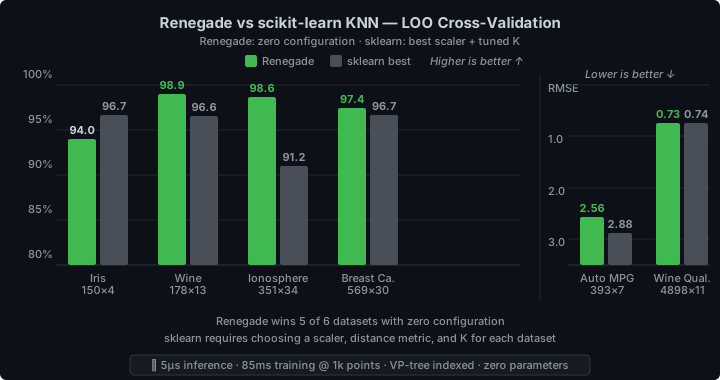
Renegade wins 5 of 6 standard ML datasets with zero configuration. sklearn requires choosing a scaler, distance metric, and K for each dataset.
Performance
| Data points | Training | Inference | Notes |
|---|---|---|---|
| 100 | 5 ms | 2 µs | VP-tree indexed |
| 1,000 | 85 ms | 5 µs | Metric learning + auto K |
| 10,000 | 1.2 s | 5 µs | VP-tree scales sublinearly |
| 100,000 | ~40 s | 56 µs | 87× faster than brute force |
- Training is amortized — only recomputes when the dataset grows 50%. The VP-tree rebuilds independently every ~20% growth (~15ms at 10k points).
- New data points are immediately queryable without retraining.
- Instance weights support recency decay for online learning.
Quick Start
cargo add renegade-ml
use renegade_ml::{DataPoint, Renegade};

#[derive(Clone)]
struct Peer {
    distance: f64,     // network distance
    latency_ms: f64,   // recent avg latency
    origin: u8,        // region (categorical)
}

impl DataPoint for Peer {
    fn feature_distances(&self, other: &Self) -> Vec<f64> {
        vec![
            (self.distance - other.distance).abs() / 1.0,       // already [0, 1]
            (self.latency_ms - other.latency_ms).abs() / 500.0, // normalize
            if self.origin == other.origin { 0.0 } else { 1.0 },
        ]
    }

    fn feature_values(&self) -> Vec<f64> {
        vec![self.distance, self.latency_ms, self.origin as f64]
    }
}

let mut model = Renegade::new();

// Add observations (with optional recency weighting)
model.add(peer_a, success_rate_a);
model.add_weighted(peer_b, success_rate_b, 0.5);  // half weight (older observation)

// Predict — auto-selects K, learns metric, builds index
let predicted = model.predict(&query_peer);             // weighted mean
let neighbors = model.query(&query_peer);               // raw neighbors
let class_probs = neighbors.class_votes();              // classification
let extrapolated = model.predict_extrapolated(&query);  // with R² confidence

// Expire stale data
model.retain(|_peer, _output| /* keep if recent */ true);
How It Works
Gower Distance + Auto K
Each feature contributes a distance in [0, 1]:
- Numeric:
|a - b| / range - Categorical:
0if same,1if different - Custom: edit distance, Jaccard, etc. — anything normalized to [0, 1]
K is selected automatically via leave-one-out cross-validation.
Effect-Space Metric Learning
For each feature, an isotonic regression learns its marginal effect on the output. Features that predict the output get high weight; noise features get zero weight. Distances are computed in this "effect space."
It's the same isotonic regression used to calibrate classifier probabilities, pointed sideways: instead of mapping scores → calibrated probabilities, it maps each feature → its marginal effect on the target, and the fit's R² becomes that feature's weight.
The metric is only kept when it demonstrably improves LOO error. Otherwise it falls back to simple Gower distance. The metric never hurts.
VP-Tree Indexing
A vantage-point tree provides exact nearest neighbor search (not approximate) with any distance function. Queries are O(log n) average case — 347× faster than brute force at 10k points.
The tree rebuilds automatically as data grows. Between rebuilds, new points are searched via a small brute-force tail scan.
Diagnostics
let diag = model.diagnostics();
// diag.optimal_k          — current K
// diag.metric_active       — whether learned metric is in use
// diag.feature_metrics     — per-feature weights and effect curves
// diag.output_stats        — min, max, mean, distinct count

let pred = model.predict_with_diagnostics(&query, k);
// pred.prediction          — predicted value
// pred.neighbors           — per-neighbor distance, output, feature breakdown
Design Philosophy
- No hyperparameters — every parameter is an opportunity for misconfiguration
- No multivariate optimization — no gradient descent, no learning rates, no convergence
- Correct by default — VP-tree gives exact results, metric fallback prevents regressions
- Online-friendly — incremental insertion, instance weighting, data eviction via
retain()
Intended Use Cases
- Routing decisions based on historical peer performance (e.g., peer selection in Freenet)
- Online learning with moderate data volumes
- Mixed-type data where features are numeric, categorical, or custom
- Low-data regimes where parametric models overfit
License
LGPL-3.0-or-later
If LGPL doesn't work for your use case, alternative licensing is available — reach out on X (@sanity) or open a GitHub issue.