Miru
[!IMPORTANT] Development is done on Codeberg with a mirror in GitHub
A Wayland-native screen magnifier and cursor spotlight tool for streamers, built for Wayland compositors supporting the required wlroots protocols. Miru is primarily developed and tested on Niri.
Inspired by boomer, but for Wayland — written in C, keybind-driven, no GUI, no mouse-required config.
See Roadmap for the full picture.
[!IMPORTANT] Miru currently requires both
wlr-layer-shell-unstable-v1andwlr-screencopy-unstable-v1. Compositors that do not expose these protocols are not currently supported.In particular, GNOME (Mutter) and KDE Plasma (KWin) are not supported at this time.
[!NOTE]
mirudevlogs on YouTube https://youtube.com/playlist?list=PLZraydlsV2t0&si=jystH8Ik1UjDVu5t
Demo
https://github.com/user-attachments/assets/be2a4561-ad53-4700-8ddc-b78a5f4eb616
Table of contents
- What it does
- Why
- Performance
- A note on global hotkeys
- Requirements
- Installing
- Building
- Running
- Man pages
- Configuration
- Project structure
- Roadmap
- Similar tools
- License
What it does
Two distinct features — one built, one planned. They share a visual similarity (dim + soft-edged circle around the cursor) but are not the same feature, and it's worth being clear about which one you're getting:
-
Magnifier mode — press a key, the screen freezes into a zoomed-in fullscreen view centered on your cursor. Move the mouse to pan, scroll or press +/- to adjust zoom, use arrow keys or WASD to pan by keyboard, press Esc (or the toggle key again) to exit. Like
boomer, but native Wayland. While active, pressing Tab toggles Cursor Highlight on top of the zoomed view — darkening everything except a soft-edged circle that follows the real pointer position across the screen (absolute tracking), even when zoomed in. Configurable via[spotlight]in the config file. This only works inside an active Magnifier session; it isn't a separate mode you can toggle on its own, and the desktop underneath is still frozen/grabbed while it's on. Built and working now. -
Spotlight mode — a fully independent, click-through overlay that darkens the whole screen except a cursor-tracking circle, while you keep working normally underneath — no freeze, no input grab, usable during normal desktop work rather than only inside a Magnifier session. This is a different, harder problem than Cursor Highlight above: it needs cursor tracking without stealing pointer/keyboard focus, which Cursor Highlight sidesteps entirely by already owning input while Magnifier is active. Not built yet.
Why
Most screen magnifiers either don't exist for Wayland, or route through XWayland
with visible artifacts and no compositor integration. Miru uses Wayland
protocols directly, currently relying on wlr-layer-shell for its overlay and
wlr-screencopy for screen capture. The overlay itself is rendered with
OpenGL ES 2 via EGL.
Performance
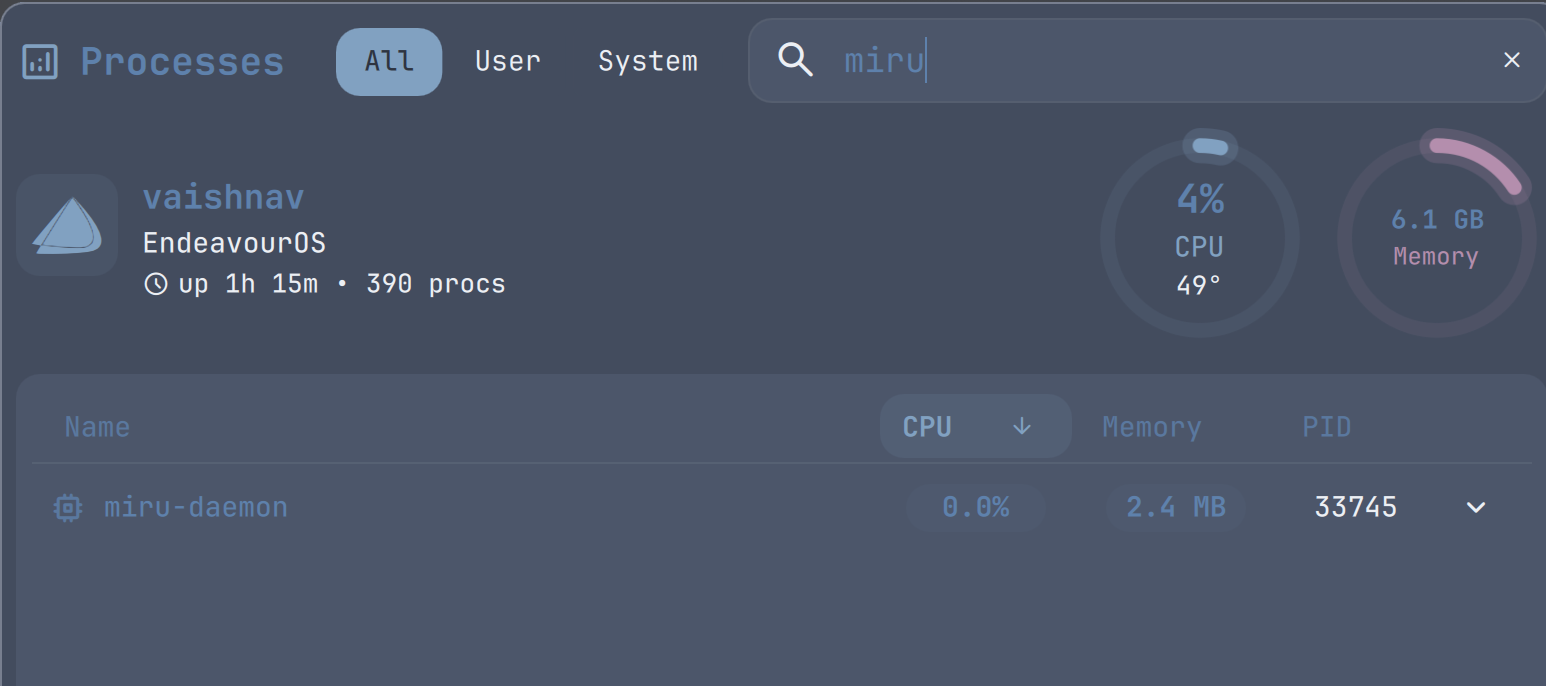
Because there's no continuous re-capture while the overlay is inactive (see
Setting up a keybind below for why), miru-daemon
sits completely idle — blocked in poll() waiting for either a Wayland event
or a toggle command — for as long as you're not actively using it. In
practice this means ~0% CPU usage at rest:
A note on global hotkeys
Miru is toggled via a compositor-level keybind (see Setting up a keybind below), not an in-app global hotkey — and this is deliberate, not a missing feature. Wayland's security model doesn't allow any client to listen for keypresses while it isn't focused; only the compositor itself has that privileged access, which is exactly why every Wayland compositor provides some way to bind a key to a command (a config file, or a GUI).
Routing through the compositor is the correct, secure way to do this — the alternative (a client reading raw kernel input events directly, bypassing Wayland's input model) means running with elevated device permissions and having the daemon read every keystroke on your system at all times just to catch one hotkey, which is a meaningfully bigger trust ask than this project wants to make for a screen-zoom tool.
Requirements
- A Wayland compositor implementing
wlr-layer-shell-unstable-v1andwlr-screencopy-unstable-v1 wayland-client,wayland-protocols,wayland-scanner(pacman:wayland,wayland-protocols)- EGL + OpenGL ES 2 development packages
- CMake ≥ 3.20, Ninja (optional)
- A C11 compiler
Compositor compatibility
Miru currently requires a compositor that exposes both wlr-layer-shell and
wlr-screencopy.
- Niri — supported and used for development/testing
- Sway — supported; both required protocols are core to the wlroots ecosystem Sway is built on
- Hyprland — supported by the required wlroots protocols
- Mango — supported if the required protocols are exposed
- GNOME / Mutter — not supported
- KDE Plasma / KWin — not supported
Support for compositors without these protocols may be added later through alternative capture and overlay mechanisms.
Installing
Arch Linux (AUR)
# latest tagged release
paru -S miru-zoom
# or track the latest commit on main
paru -S miru-zoom-git
Substitute your AUR helper of choice — yay, paru, or a manual
makepkg -si against the PKGBUILD.
Nix / NixOS
Run directly without installing:
nix run git+https://codeberg.org/Vaishnav-Sabari-Girish/miru
Or install to your profile:
nix profile add git+https://codeberg.org/Vaishnav-Sabari-Girish/miru
For development:
nix develop
Homebrew (Linuxbrew)
brew tap Vaishnav-Sabari-Girish/tap
brew install miru
From source
See Building below.
Building
# Using Ninja
cmake -S . -B build -G Ninja -DCMAKE_EXPORT_COMPILE_COMMANDS=ON
# Using Make
cmake -S . -B build -G "Unix Makefiles" -DCMAKE_EXPORT_COMPILE_COMMANDS=ON
Then run:
cmake --build build
Or with Grimoire:
grim cast build # Uses make to build by default
This builds two binaries: miru-daemon (the actual Wayland client) and
miructl (a tiny, Wayland-independent socket client used to control it).
Installing the built binaries
To install miru-daemon and miructl to ~/.local/bin:
cmake --install build
Or with Grimoire, which also configures CMAKE_INSTALL_PREFIX for you:
grim cast install
Running
You can run miru-daemon directly in the foreground, or set it up as a
systemd user service so it starts automatically with your graphical session.
Running directly
./build/miru-daemon
# or
grim cast run-daemon
As a systemd user service
Create ~/.config/systemd/user/miru.service:
[Unit]
Description=Miru Zooming Daemon
PartOf=graphical-session.target
After=graphical-session.target
ConditionEnvironment=WAYLAND_DISPLAY
ConditionPathExists=%h/.local/bin/miru-daemon

[Service]
ExecStart=%h/.local/bin/miru-daemon
Restart=on-failure
RestartSec=1

[Install]
WantedBy=graphical-session.target
This assumes miru-daemon has been installed to ~/.local/bin (see
Installing the built binaries above) — adjust
ExecStart/ConditionPathExists if yours lives elsewhere.
Then enable and start it:
systemctl --user enable --now miru.service
Either way, once running, miru-daemon connects to the compositor, logs
every advertised protocol, opens a Unix socket at
$XDG_RUNTIME_DIR/miru.sock, and then idles — no overlay is shown until told
to toggle. Nothing else happens until a toggle command arrives (see
Performance above for what that idling actually costs).
Toggle the overlay on/off:
./build/miru-daemon --version # prints version info + an ASCII logo, exits immediately
./build/miructl toggle        # freezes + zooms the screen / returns it to normal
./build/miructl quit          # tells the daemon to shut down
Man pages
miru-daemon and miructl each have their own man page. How you access
them depends on how you installed Miru:
- Installed via
miru-zoom-git(AUR),cmake --install build, orgrim cast build/grim cast install— no extra step,man miru-daemonandman miructlwork immediately. - Homebrew — not wired up yet, coming soon.
- Built from source but not installed to
$PATH— pointmanat the page directly from the repo root:
  man ./miru-daemon.1
  man ./miructl.1
Configuration
Miru uses a TOML configuration file located at:
$XDG_CONFIG_HOME/miru/config.toml
If XDG_CONFIG_HOME is not set, Miru follows the XDG fallback and uses:
$HOME/.config/miru/config.toml
The directory and default configuration file are created automatically on first launch.
The default configuration is:
[zoom]
factor = 2.0
increment = 0.25
max_factor = 10.0
smooth = false

[spotlight]
radius = 250
dim = 0.65
softness = 20

[general]
show_cursor = true
The currently active options are:
zoom.factor— initial zoom level applied on each toggle-on. Must be at least1.0.zoom.increment— amount the zoom changes per key/scroll input. Must be greater than0.zoom.max_factor— maximum zoom level. Must be at least1.0.zoom.smooth— whentrue, zoom level and pan position are smoothly interpolated toward their targets instead of snapping.spotlight.radius— radius, in pixels, of the fully-bright circle around the cursor.spotlight.dim— how much darker the dimmed area gets, from0.0(no effect) to1.0(fully black).spotlight.softness— width, in pixels, of the feathered transition between the bright circle and the dimmed area.general.show_cursor— currently parsed; runtime effect is still limited.
Invalid numeric values, including malformed, overflowing, non-finite, and
non-positive values where applicable, fall back to safe defaults. zoom.factor
is clamped to zoom.max_factor when necessary.
[!NOTE]
[spotlight]values are live — they control the Cursor Highlight effect toggled with Tab while Magnifier mode is active. They're named[spotlight]in the config because they'll be shared with standalone Spotlight mode once that's built, not because Cursor Highlight and Spotlight mode are the same feature.
The config file is watched while miru-daemon is running — saving changes
takes effect immediately, no restart needed. zoom.max_factor, zoom.smooth
and every [spotlight] value update live, including on an already-active
overlay; zoom.factor (the initial zoom on toggle-on) takes effect starting
with the next toggle, since retroactively snapping an in-progress session to a
different zoom level would be jarring rather than useful.
Additional input, zoom and texture-upload diagnostics can be enabled by
setting MIRU_DEBUG to a non-zero value:
MIRU_DEBUG=1 ./build/miru-daemon
Setting up a keybind
You'll want this bound to a key rather than run manually. Each supported compositor has its own way to bind a command to a key:
[!NOTE] Make sure
miru-daemonis already running before triggering the keybind, ormiructlwill fail with a connection error.
Niri — ~/.config/niri/config.kdl:
Mod+Z hotkey-overlay-title="toggle miru" { spawn-sh "/path/to/miru/build/miructl toggle"; }
Hyprland — ~/.config/hypr/hyprland.conf:
bind = SUPER, Z, exec, /path/to/miru/build/miructl toggle
Sway — ~/.config/sway/config:
bindsym $mod+z exec /path/to/miru/build/miructl toggle
Mango — ~/.config/mango/config.conf:
bind=SUPER,Z,spawn,/path/to/miru/build/miructl toggle
Substitute the actual path to your built miructl binary in each case (or
wherever it ends up if installed via a package manager).
On toggle-on, the daemon captures one frame via wlr-screencopy, uploads it
as an OpenGL ES texture, and shows it in a fullscreen wlr-layer-shell
overlay (correctly scaled on HiDPI outputs) at the configured zoom factor,
centered on your cursor. While active:
- Move the mouse to pan the zoomed view
+/-or scroll wheel to adjust the zoom level- Arrow keys or WASD to pan by keyboard — press and hold for continuous panning at your keyboard's repeat rate
- Tab to toggle Cursor Highlight on/off — darkens everything except a
soft-edged circle that follows the real pointer position across the
screen (absolute tracking), using the
[spotlight]config values. This is separate from the standalone Spotlight mode described above; see What it does for the distinction. - Esc, or pressing the toggle keybind again, to exit back to your normal desktop
There's deliberately no continuous re-capture of the underlying screen while
the overlay is visible: an earlier version tried that and hit a feedback loop
where the overlay could end up capturing itself (e.g. during Alt+Tab), so the
frozen frame is captured once per toggle-on, matching boomer's actual
freeze-on-demand behavior rather than a live feed. Zooming/panning/Cursor
Highlight within that one frozen frame is fully live, however.
The overlay grabs keyboard and pointer input while active (needed for pan/zoom/Cursor Highlight to work), so clicks and most keys won't reach whatever's underneath until you exit; that's expected for Magnifier mode. A future standalone Spotlight mode would behave differently — click-through by design, see What it does above.
Project structure
.
├── CMakeLists.txt
├── cmake/
│   └── WaylandScanner.cmake          # wraps wayland-scanner as CMake custom commands
├── protocol/                         # vendored protocol XML (not shipped by wayland-protocols)
│   ├── wlr-layer-shell-unstable-v1.xml
│   └── wlr-screencopy-unstable-v1.xml
├── src/
│   ├── main.c                        # daemon entrypoint, IPC-driven toggle loop
│   ├── wayland_state.h/.c            # connection, registry, seat/output tracking, poll-based event loop
│   ├── layer_surface.h/.c            # wlr-layer-shell overlay, zoom/pan, Cursor Highlight, GL draw
│   ├── capture.h/.c                  # one-shot screen capture via wlr-screencopy
│   ├── shm_buffer.h/.c               # shared-memory pixel buffer allocation helper
│   ├── egl_context.h/.c              # EGL display / context / window-surface setup
│   ├── gl_renderer.h/.c              # OpenGL ES 2 shaders, texture upload, spotlight draw
│   ├── ipc_server.h/.c               # Unix socket server, parses toggle/quit commands
│   ├── input.h/.c                    # pointer/keyboard listeners: pan, zoom, Tab highlight, key-repeat, Esc
│   ├── config.h/.c                   # config discovery, defaults, validation and loading
│   ├── config_watch.h/.c             # inotify-based watch on the config directory, drives hot-reload
│   ├── toml.h/.c                     # minimal TOML parser used by the config loader
│   ├── version.h.in                  # CMake-configured version string (git describe)
│   ├── logo.h                        # ASCII logo module interface
│   └── logo.c                        # ASCII logo data and printing implementation
├── ctl/
│   └── miructl.c                     # thin socket client, no Wayland dependency
└── Grimoire.toml                     # dev task runner (build/run/install/clean)
Roadmap
- Wayland connection, registry discovery, manual poll-based event loop
- Fullscreen
wlr-layer-shelloverlay surface - Screen capture via
wlr-screencopy - Render the captured frame into the overlay (OpenGL ES + EGL, scale-aware)
-
miructlcontrol client + Unix socket IPC, daemon/client split - Keybind-driven toggle: capture + show on activate, tear down on deactivate, no continuous re-capture while visible
- Magnifier mode: cursor-centered zoom + live pan, mouse/keyboard/WASD/ scroll zoom controls, proper multi-key repeat
- TOML configuration with XDG config directory support and configurable zoom/spotlight behavior
- Cursor Highlight (Tab): darken + feathered cursor cutout that follows the real pointer position (absolute tracking) even while zoomed
- systemd user service +
cmake --install/grim cast installsupport - Hot-reloading of the config while
miru-daemonis running -
manpages formiru-daemonandmiructl - Optional smooth interpolation for zoom/pan (
zoom.smooth) - Spotlight mode: standalone, click-through overlay (no Magnifier freeze, works alongside normal desktop use)
- Cursor tracking for Spotlight mode without stealing input (likely Niri IPC or similar)
- Multi-monitor support
- Support compositors without
wlr-screencopy/wlr-layer-shell
Similar tools
woomer—boomerfor Wayland, written in Rust (usesraylib)hyprmagnifier— a wlroots-compatible Wayland magnifier that does not suckcboomer— a port ofboomerwritten in Ccboomer(DavidBalishyan) — a different port ofboomer, also written in Czoomer— a port ofboomerwritten in Zig, with Wayland support and an X11 fallback
License
See LICENSE.
🧠 (mostly) Brain made
This project was NOT vibe-coded BUT AI is still involved in some parts of it.
- Micro-improvements: I have used AI as an advisor to improve some bits of
code here and there. Big refactors or new features are done by my hand though.
